

Every retail assortment choice affects capital, shelf productivity, and category growth. Stock the wrong products, and you tie up inventory; miss a rising brand and a competitor captures demand that could have strengthened your shelf.
Key Takeaways
- GMV, market share, and items sold by SKU are better sourcing signals than social views alone because it shows which brands convert attention into revenue.
- Benchmarking only works when you compare the right peers: same category, price point, audience, and growth stage.
- Distributed creator performance is stronger than a single viral moment because it shows demand is repeatable.
- The strongest sourcing opportunity is brands with proven DTC and TikTok Shop momentum not yet at broad offline distribution.
Why Traditional Retail Assortment Planning Misses Emerging Brand Demand.
Traditional assortment planning relied on trade show relationships, sales rep pitches, and lagging sell-through reports, so buyers often evaluated brands after demand had moved elsewhere. By the time a brand appeared in a line review, the next wave of demand was often forming on TikTok Shop, DTC sites, and creator-led commerce channels.
Emerging brands are proving demand long before they reach a shelf, so retailers need earlier signals that show whether online attention is converting into consistent sales.
Tips for Using Data to Identify Fastest-Growing Brands for Your Assortment
Finding the right brands to carry is not a one-time gut call. It is a repeatable process when you have the right data backing it. The tips below walk through how to move from broad category signals down to a shortlist of brands worth adding to your shelf.
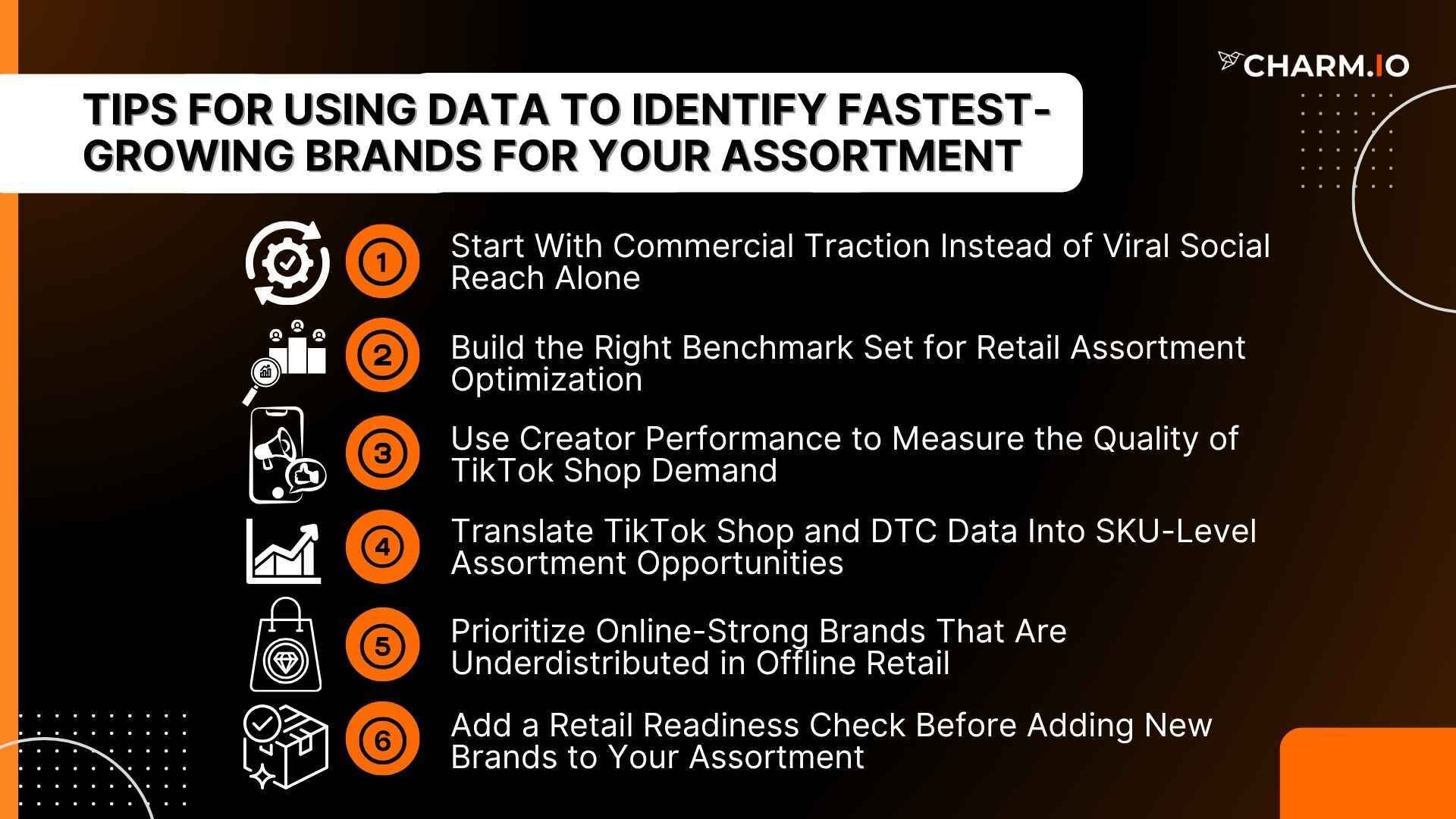
1. Start With Commercial Traction Instead of Viral Social Reach
The first instinct when scouting brands on social platforms is to chase views, but virality alone rarely proves that a product belongs in a retail assortment. The stronger foundation is commercial traction: which brands are generating consistent revenue, SKU velocity, and repeat purchase behavior where shoppers already buy.
TikTok Shop data can show GMV by category, top-selling SKUs, shop-level performance, and creator activity driving conversion. Revenue data surfaces brands that have solved the hardest part of the equation: getting consumers to buy repeatedly, not just click once.
Charm's TikTok Shop analytics gives retailers a category-level view of brands and products generating measurable GMV.
2. Build the Right Benchmark Set for Retail Assortment Optimization
One common mistake in product assortment optimization is benchmarking against the wrong peers because challengers, legacy CPG brands, and creator-led TikTok Shop brands can share a category while operating at different price points, growth stages, and customer expectations. The useful comparison happens within a tightly defined peer group: same category, similar price point, comparable audience demographics, and overlapping growth trajectory.
Good benchmarking tools let you filter by category, revenue range, growth rate, market share, and brand characteristics. With the right comparison group, you can rank brands by GMV performance, assortment depth, and growth momentum rather than broad popularity.
This is where assortment decisions shift from gut feel to evidence: you are asking whether a brand performs well relative to true peers and whether momentum is likely to hold in retail.
Charm's Brand Explorer and TikTok Shop analytics are tools built for this step, letting you narrow a field of candidates by category, size, and growth signals before investing time in deeper evaluation.
3. Use Creator Performance to Measure the Quality of TikTok Shop Demand
Creator-driven sales on TikTok Shop create a sourcing risk: a brand can appear strong because of one viral post, even when performance is concentrated in a single moment that rarely translates into sustained shelf velocity. The stronger signal is distributed creator performance because multiple creators driving steady conversion across content styles, audience sizes, and buyer segments indicate product-market fit rather than a lucky spike.
Metrics like revenue per creator, active creators contributing to sales, and conversion efficiency or ROAS across the creator base give a clearer picture of demand quality. Several creators driving purchases is safer than one viral video with no consistent conversion behind it.
Furthermore, it’s important to see that creators driving purchases for a brand or product are part of a rising trend with staying power. If creators were talking about this brand or product at one point, but the viral moment has passed, it may be worth reconsidering adding it to your assortment.
4. Translate TikTok Shop and DTC Data Into SKU-Level Assortment Opportunities
Once you have identified commercially strong brands with distributed creator demand, the next step is translating that signal into an actual assortment planning decision. That means going beyond "this brand is performing well" to understand the specific SKU-level story.
A few questions worth working through for each candidate brand:
Which SKUs are winning repeatedly?
A brand with one breakout product is interesting. A brand with three to five consistently strong SKUs across a category is a credible long-term partner.
What does the pricing ladder look like?
Understanding where a brand sits relative to your existing shelf helps identify whether it fills a gap, displaces an underperformer, or competes directly with something already working.
Where is the assortment whitespace?
Comparing a brand's product mix against your current set can surface formats, price points, or subcategories that are underrepresented. That is where assortment planning creates genuine category growth rather than just swapping one product for another.
What are the audience demographics?
A brand with a strong Gen Z or millennial customer base may be exactly what a category needs if the current shelf skews older and the goal is to attract new buyers.
5. Prioritize Online-Strong Brands That Are Underdistributed in Offline Retail
The clearest sourcing opportunity is brands with real DTC and TikTok Shop momentum that have not yet reached broad offline distribution. These brands have validated demand, proven repeat purchase behavior, and built audience loyalty, but still lack the physical or broader retail presence that can unlock the next stage of growth.
That combination is valuable because you are giving proven demand access to a new channel, which tends to grow volume rather than cannibalize existing demand.
Charm surfaces this type of brand by combining TikTok Shop analytics with DTC performance data, growth scores, and competitive benchmarking. The result is a structured way to see which emerging brands have the commercial foundation to support retail placement and which are still too early or too dependent on a single traffic source.
6. Add a Retail Readiness Check Before Adding New Brands to Your Assortment
Data can take you most of the way, but a final readiness check protects against sourcing a brand that performs online but cannot execute at scale. Before adding a new product assortment partner, ask:
- Does the margin structure work for your retail model?
- Is the packaging shelf-ready or does it need adjustment?
- Can the brand support the volume and fulfillment timelines you need?
- Is there exclusivity potential or is the brand already in competing doors?
- Do social trends show this brand/product has staying power and isn’t part of a viral moment that has already passed?
- Does offline expansion create meaningful cannibalization risk for their DTC business?
These questions sit outside what analytics can answer directly, but they are easier to get right when you have already filtered your candidate list down to brands with durable, data-backed demand.
Where Data-Led Retail Assortment Planning Creates the Most Category Growth
Data-led retail assortment planning creates the most upside in categories where consumers still pay for differentiation, brand story, product innovation, and identity-driven discovery. Health and wellness and skincare and beauty lead because challenger brands can earn interest even when legacy brands still hold preference.
Value-driven categories like food, beverage, and household staples are harder because price pressure compresses the advantage of a strong brand narrative. Knowing where category dynamics favor challenger brands, then using TikTok Shop and DTC data to identify the right challenger, is the clearest path to differentiated assortment.
Build a Smarter Retail Assortment With Charm
Charm gives retailers access to TikTok Shop GMV data, brand benchmarking, creator performance analytics, and DTC intelligence.
If your team wants to sharpen its sourcing process and find the brands worth adding before competitors do, book a call with Charm to see how the platform supports category discovery and brand evaluation.
See what’s trending in your industry
Charm’s Trend Watch is a monthly webinar that shares data and insights into fast-growing DTC brands, TikTok Shop trends, and strategic market opportunities.
Sign up for the Webinar