

October 14, 2026
Ajay Salpekar, GM of beauty, food and beverage at TikTok Shop, expects beauty sales on the social commerce platform to significantly surpass last year’s holiday season, when e-commerce intelligence firm Charm.io estimated that sales for the category peaked at $392.8 million in November.
The optimistic outlook comes amid market-wide forecasts for a strong holiday shopping season, with Deloitte forecasting overall retail sales growth of 4% to 4.8% and e-commerce sales growth of 7.5% to 8.4%. It also follows a period of explosive beauty growth at TikTok Shop that has begun to moderate.
Beauty and personal care sales on the platform approached $1 billion in each of the first three quarters of 2026, advancing by 39% from the same year-ago period to reach $992.9 million in the third quarter, per Charm.io. Year-over-year growth dropped from 96% in the first quarter to 82% in the second quarter and 39% in the third quarter.
TikTok Shop is projecting that livestream shopping, gift sets and discovery kits and K-Beauty will drive holiday purchases. Livestreaming, in particular, has become an important sales engine. Charm.io data shows that TikTok Shop’s 10 leading beauty livestreaming sellers generated more than $83 million in the first half of 2026, led by Korean skincare brands Medicube and Dr. Melaxin, with $19.4 million and $13.3 million, respectively.
Major beauty players are embracing the format. On Oct. 6, Rihanna hosted a Fenty Beauty livestream on TikTok, showcasing the brand’s new Pro Filt’r Fluid Flex Foundation, holiday gift sets and a new collaboration with phone case company Casetify. Meanwhile, Sephora is leveraging live shows to highlight its monthly product drop strategy on TikTok Shop.
Beauty Independent sat down with Salpekar to discuss the platform’s holiday business, the role of livestreaming, beauty categories and products anticipated to resonate with shoppers and how brands can position themselves for the season.
How are you feeling about TikTok Shop’s beauty performance heading into the holiday season?
It will be significantly bigger than last year for the total platform, but also the beauty categories. One of the things that will be different this year is that live will play a much bigger role than it did last year. Last year we had many creators having mega lives and that will also be the case this year.
This year, brands themselves going live is a much bigger proportion of our business. We expect multiple brands to have mega lives. Because of the live interaction model being so good for user engagement, more brands are going live compared to last year, and they’re going live for longer.
Every year we see gift sets, advent calendars, bundles, regimen packs and discovery sets do extremely well, and this year is no exception. Sephora launched an advent calendar for its last Drop Shop, a whole giftable set of goodies that’s doing extremely well, particularly through live. Sets will play an even bigger role this Q4 than last Q4.
Within Korean beauty, makeup is trending much more. It’s no longer just skincare. Haircare is also starting to pick up. In fragrance, the trend is there’s a lot more body mists and also body mist/EDP duos.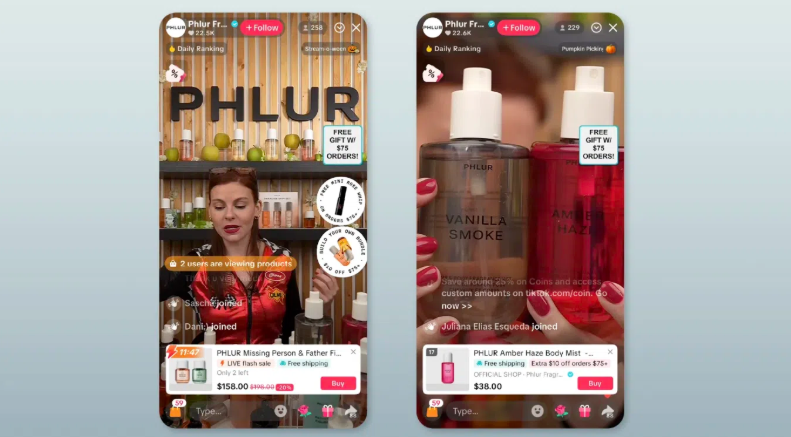 Beauty brands on TikTok Shop will leverage live selling in a bigger way this holiday season, according to Ajay Salpekar, GM of beauty, food and beverage at the platform.
Why are more beauty brands investing in livestreaming, and what makes the format particularly effective?
There are a few reasons. The first is that in live, you are able to demonstrate products in a way that you could through short video, but you don’t have the two-way feedback loop, and in live you absolutely do. The demonstrability of products in the beauty category is quite high.
The second reason is brands get to tell their own stories, not just through creators, and brands are starting to value that even more. A classic example is when E.l.f. Cosmetics launched haircare for the first time. They chose to launch it on TikTok Shop first, and live was a very big part of it.
If you’re launching a new product or it’s a first to market or first in brand, it requires more education. Live can give you much more education than a static product detail page that we used to see on a retailer-dot-com, brand-dot-com.
What we’ve also seen shift first is brand appetite and also the host/talent capability. We launched a product feature called Auction Live earlier this year, and that makes the live interaction model even more interesting because it’s time-bound.
Brands will do educational components. They might have a quick flash sale, they’ll go back to their regular programming and then they’ll introduce an auction product, and it really drums up excitement. Whether or not you as a user participate, it’s fun to watch. That is just another element in making you want to tune in more, even if you’re just watching it in the background.
Is livestreaming more effective for acquiring new customers or driving repeat purchases?
Brands are still discovering that. We know it is great at driving repeat behavior because it creates this expectation and interest to tune in. I think as the quality improves across the board, if you’ve never watched a live, you might eventually be more likely to click into it. As a user, if you like a live, you tend to follow the brand, which then notifies you the next time they go live.
Beyond livestreaming, what strategies should beauty brands prioritize on TikTok Shop this holiday season?
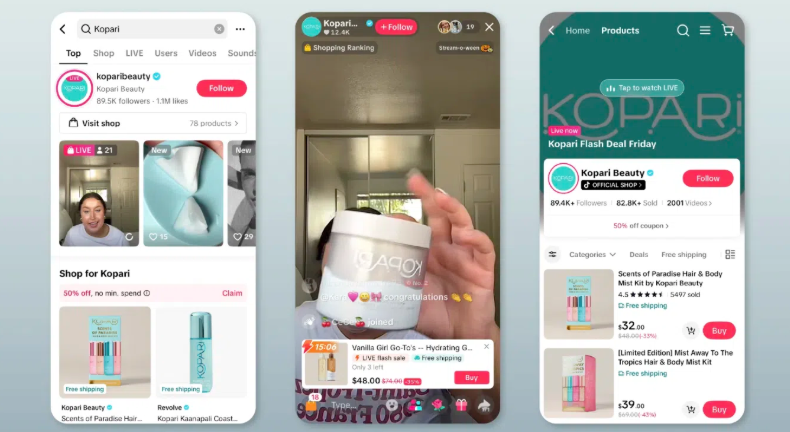
In the early years, TikTok Shop may have been an afterthought. Brands didn’t plan for it. We now see brands plan months in advance for which advent calendars, discovery sets that they will launch on TikTok Shop, whether or not they’re in brick-and-mortar. Q4 is a great time for customer acquisition. Launching these holiday specific assortments early using both creative short video and live, that’s a good way to acquire customers.
A tactic that we see many brands use is this vehicle we call brand campaigns. For a few years now, we’ve had the capability for brands to launch a Super Brand Day, which is a week or so highlight on a brand. Particularly in beauty, the campaigns that work well are new arrivals where it is all themed around the launch of a new offering or line extension. We have more brands than ever that have planned in quarter four brand campaigns well in advance to bring some of this assortment.
E.l.f. Cosmetics was the first brand in the U.S. to ever try a Super Brand Day. They will be the first brand to also have a global Super Brand Day later this month where they will have an activation at the same time across multiple TikTok Shop markets. Every year TikTok Shop gets pulled a little closer into brands’ core strategies because of the role it’s assumed in discovery and brand building in the beauty industry.
 TikTok Shop generated more than $500 million in sales in the United States during the four-day Black Friday/Cyber Monday weekend last year. According to Charm.io, beauty and personal care sales surpassed $109 million between Thanksgiving and Cyber Monday, advancing 55% year over year and accounting for more than 20% of platform sales.
Why has K-Beauty been so successful on TikTok Shop, and do you expect its momentum to continue?
I do think the momentum will continue, especially as the industry sees Korean beauty brands go from not being known at all to being discovered to being on the shelves at an Ulta, Sephora or Target. It started with skincare, but we are also seeing Korean makeup brands and haircare brands now. If you visit Korea, there are a whole host of fantastic fragrance brands that I wish were available in the U.S.
The reason is, one, it is a very effective way for them to enter a market through digital and creator content instead of the traditional way. Two, and this is very key, almost no part of the industry has as fast innovation cycles for product innovation as Korean manufacturers do. The speed of innovation results in more bundles, more launches, more new fresh content for users, but new opportunities for creators to tell stories. Any fast innovation category where there’s a lot of newness is a great fit for TikTok Shop discovery.
The other thing is a lot of the products can be very visually appealing and demonstrable and lend themselves to video or live. These brands tend to be very progressive about creator partnerships and less restrictive because they recognize that, while you can certainly brief creators, their authentic, at-scale storytelling is what drives very quick content production and then the halo impact from it.
The final thing is the positive reinforcement that users see and then brands see from success on TikTok Shop, driving success in the broader market, brick-and-mortar distribution, which then encourages more brands to participate in the platform. That’s the cycle that’s working really well right now.
What can other beauty brands learn from K-Beauty’s approach to TikTok Shop?
Different combinations and bundles and the experimentation. These brands have gotten really good at participating in creator events, too. We organize creator-brand matchmaking events, and K-Beauty brands generally participate in those events at a high rate.
In general, they’re just very open to creator partnerships, and those are things that are transferable, even if the fast innovation cycle may not transfer as well.