

October 13, 2026
TikTok Shop’s beauty business in the United States continues to grow rapidly, but its momentum has slowed considerably this year as quarterly sales appear to plateau just below the $1 billion mark and sales productivity per video declines.
Beauty and personal care sales reached $992.9 million in the third quarter, a 39.1% increase from the same period last year, according to a new report from e-commerce intelligence firm Charm.io. The growth rate represents a deceleration from the first quarter, when beauty sales surged 96% year-over-year to $928.5 million, and the second quarter, when they climbed 82% to approximately $980 million. Quarterly growth has also moderated, easing from 6% between the first and second quarters to 1.3% between the second and third.
Beauty’s growth lagged TikTok Shop’s overall growth in the third quarter. Total sales in the United States on the platform across categories increased 3.1% quarter over quarter to $5.87 billion, compared with beauty’s 1.3% increase.
Competition for shoppers’ attention is intensifying. Bryan Wood, senior e-commerce insights research analyst at Charm.io, notes that while the number of shops, creators and products on TikTok Shop has generally grown in line with beauty sales, the volume of videos swelled much faster. In the third quarter, the number of active beauty product videos surged 76% year over year to 10.4 million, nearly twice the category’s revenue growth rate.
As a result, quarterly beauty gross merchandise value (GMV) per active video, calculated by dividing total category sales by the number of active beauty product videos, has fallen sharply. The figure dropped from approximately $379 in the third quarter of 2024 to $121 in the same period last year and $96 in the latest quarter, a decline of nearly 75% over two years.
Wood explains, “Shops are putting out far more videos, but getting much less value out of them than they were a year ago, suggesting increased competition. Brands need to be sure to focus more on partnering with creators to produce high-quality videos that are more likely to convert rather than solely focusing on putting out a high volume of videos.”
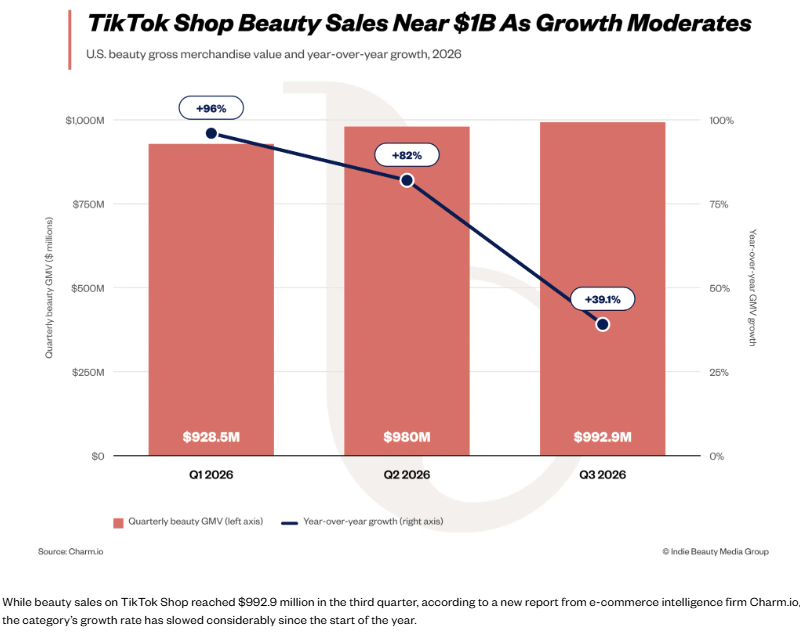
Despite the slowdown in growth and declining video productivity, beauty remains one of TikTok Shop’s largest categories. In the 12 months ending in September, beauty and personal care sales totaled $3.91 billion, up 67.3% from the preceding year and representing 17.8% of total platform sales. Since March, monthly beauty sales have been between $317.7 million and $342.7 million, below their November 2025 peak of $392.8 million.
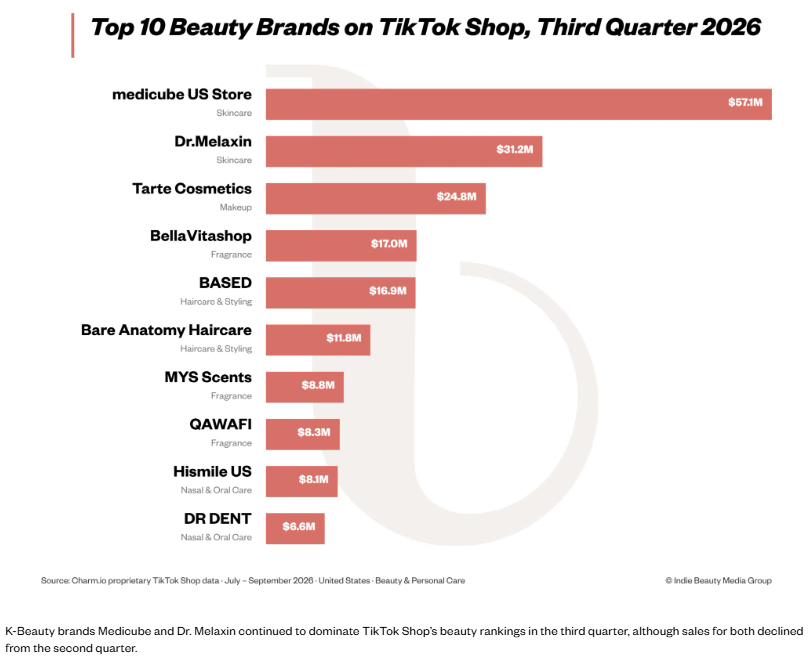
K-Beauty brands continued to dominate TikTok Shop’s beauty rankings in the third quarter, but the platform’s two largest K-Beauty sellers experienced sales dips. Medicube retained the top position with $57.1 million in sales, down approximately 9% from $62.8 million in the second quarter. Dr. Melaxin remained in second place, generating $31.2 million, a nearly 20% decline from $38.8 million. Together, the two brands accounted for 8.9% of TikTok Shop’s beauty sales in the third quarter.
Tarte Cosmetics held steady in third place, up slightly from $24.3 million in the previous quarter to reach $24.8 million. There was more movement further down the rankings. Fragrance seller BellaVitashop jumped from sixth to fourth place as sales surged approximately 83% to $17 million. Men’s grooming and haircare brand Based slipped from fourth to fifth. However, its sales climbed from $15.9 million to $16.9 million.
Four brands entered the top 10 ranking in the third quarter: Bare Anatomy Haircare, fragrance sellers MYS Scents and Qawafi, and oral care brand Dr Dent. Collectively, the 10 leading shops generated $190.6 million, representing 19.2% of TikTok Shop’s third quarter beauty sales.
Medicube’s dominance extended to individual products. Four of the platform’s 10 bestselling beauty products came from the brand, generating a combined $21.6 million. Its Smooth & Clear Body Set led the rankings at $7.7 million, followed by its PDRN Collagen Multi Balm at $5.4 million.
Fragrance performed strongly at the product level. BellaVita’s Honey Oud Eau de Parfum and Qawafi’s Voyage Nova Extrait de Parfum each generated approximately $5.2 million, ranking third and fourth, respectively. Three of the 10 bestselling products were multi-product sets.
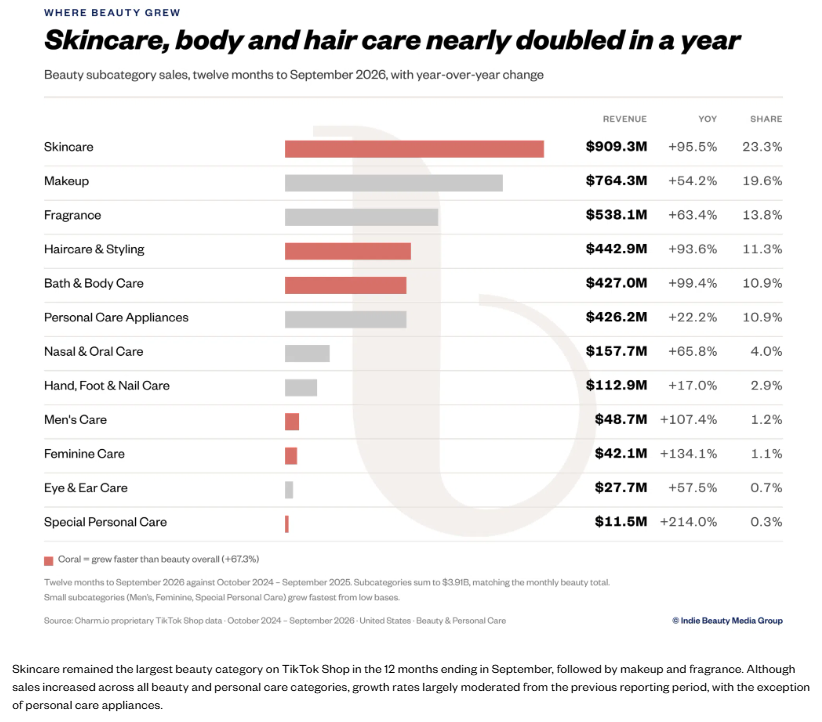
Skincare remained TikTok Shop’s largest beauty subcategory in the 12 months ending in September, generating $909.3 million in sales. Makeup followed at $764.3 million and fragrance at $538.1 million. Haircare and styling reached $442.9 million, while bath and body care generated $427 million.
As with beauty generally, growth rates across most beauty subcategories moderated from the previous reporting period. Skincare growth slowed from 123% in the 12 months ending in June to 95.5% in the 12 months ending in September. Fragrance growth eased from 87% to 63.4% and haircare and styling from 118% to 93.6%.
Makeup growth moderated from 69% to 54.2%, and bath and body care from 113% to 99.4%. Personal care appliances were a notable exception, with their annual growth rate accelerating from 15% to 22.2% between the two reporting periods and sales reaching $426.2 million
Products with longevity-focused skincare ingredients and botanical haircare formulations resonated with beauty shoppers on TikTok Shop during the third quarter, according to the report. Within skincare, sales of products mentioning NAD+ increased 773.5% between March and September, reaching $5.6 million. Products referencing epidermal growth factor (EGF) surged 3,644.4% to $4.9 million. PDRN-related products generated $10.7 million in September, up 47.8% from March but below their peak in June.
In haircare, rice water emerged as a particularly fast-growing ingredient, with sales of products mentioning it skyrocketing 1,810.4% between March and September to $3.5 million. Rosemary-focused products increased 36.9% to $8.2 million. Bare Anatomy was a major beneficiary of the rice water trend, with three products accounting for more than 90% of quarterly sales associated with the ingredient. Charm.io’s analysis tracks sales of products mentioning specific ingredients in their listings rather than independently verifying formulations or efficacy.
After analyzing the top 1,000 bestselling beauty products on TikTok Shop, Charm.io found that K-Beauty or Korean origin was the largest claim category by associated revenue on the platform during the third quarter. The 121 products explicitly identifying themselves as Korean or K-beauty generated $82.7 million during the period, accounting for 17.6% of sales among the top 1,000 products.
Anti-aging and firming claims followed at $75.8 million. Products emphasizing long-lasting or waterproof performance generated $70.1 million. Hydrating and moisturizing claims were associated with $69.9 million in sales, and clean or free-from claims with $62.4 million.