


June 4, 2026
The influencer known as OverSpray Jay has become one of the top sellers of men’s fragrances on TikTok in part by offering his followers a very specific piece of advice: Whatever scent they are wearing, they should spritz themselves 100 times.
His catchphrase: “If you ain’t shinin’, are you even applyin’?”
It is a far cry from how fragrance was marketed in the past to men – and the women who often bought it for them – with campaigns focusing on outdoor pursuits, rippling torsos and smelling “like a man, man”.
Now, the approach is more nuanced. Instead of having an instantly recognisable cologne, men are being encouraged to layer their fragrances, wearing multiple perfumes or colognes at once to create a signature scent. The trend is a boon to cosmetics companies as consumers buy several products instead of just one, often adding lotions, high-end deodorant and body washes to their haul.
Meanwhile, the number of influencers hawking fragrances to men on TikTok has increased around twelvefold from April 2024 through April 2026, according to data from Charm.io analysed for Bloomberg News. That far outpaces the eightfold increase in those marketing to women, the data shows.
Corporations and influencers alike are capitalising on a post-pandemic boom in fragrance in the US, particularly among men. The amount spent on men’s fragrances on TikTok’s shopping platform each month has outpaced that spent on women’s scents for the past two years or so, according to Charm.io, and peaked at US$18 million (S$23 million) in sales in November 2025.
The surge in demand is one of the reasons cosmetics giant Estee Lauder Companies was keen to acquire Spain’s Puig Brands, according to analysts. Puig owns brands including Penhaligon’s, Byredo, Rabanne and Jean Paul Gaultier, and had the second-largest share of the men’s premium fragrance market in 2025, at 16 per cent.
Estee Lauder and Puig recently ended discussions about a potential deal, after months of negotiations.
Evan Hall, a 23-year-old influencer based in Fayetteville, Arkansas, who posts as @fragranceknowledge, said most of his 1.1 million TikTok followers are 18- to 24-year-old men. Many are seeking creativity and innovation from products, and can be ruthless when they do not see it, he said.
If a brand launches what is known as a flanker – a new iteration of an existing fragrance – it can be seen as a cash grab. “A lot of the market sees through it,” Hall said.
Because of their high prices, premium fragrances make up a much larger share of sales versus mass-market items. They comprised about 86 per cent of the total US$16 billion in US fragrance sales in 2025, according to data from Euromonitor analysed by Bloomberg Intelligence.
At Sephora, a 100ml bottle of Angels’ Share Eau de Parfum by Kilian Paris costs US$415, while the same size of Dior Sauvage Elixir is US$265.
Beauty executives think there is still room to grow across all categories. Among men, fragrance use is highest in Europe, followed by the US and then Asia.
But “there is no region in the world that has 100 per cent usage”, said Jean Holtzmann, chief brand officer of prestige fragrances at Coty Inc, which is behind lines such as Calvin Klein and Hugo Boss.
Younger consumers on the hunt for scents
Shifting demographics in the US underpin the bullishness too.
Latino men wear fragrances more frequently than other groups, data from market research firm Circana shows – and they are a growing portion of the US population.
Meanwhile, fragrance executives say younger consumers are more likely to buy online without smelling first, accelerating the market. Fragrance has been the fastest-growing category across the US beauty industry for the past two years, according to Circana.
A tie-up between Estee Lauder and Puig would have helped the US company make up ground against L’Oreal, which dominates the No. 1 spot for global fragrance sales with a 12 per cent share of the market in 2025, the Euromonitor data shows.
Influencer Paul Fino, 26, said that when he started posting about fragrances a few years ago, “nobody really cared”.
In the past 12 months, he has promoted perfumes by Balmain, Philosophy and Armani, and amassed a collection of 5,000 fragrances while being paid to fly around the US promoting brands.
He has also noticed a recent spike in interest among his 13- to 18-year-old followers.
“They’re saving up their money to purchase this US$400 bottle of cologne from Creed,” Fino said.
Their expensive enthusiasm reminds him of a similar demographic about a decade ago who obsessively followed drops from sneaker and streetwear brands such as Supreme. The next generation of teen boys is “into these niche fragrances”, Fino said.
OverSpray Jay, who asked not to be identified by his real name due to privacy concerns, has leaned into the same phenomenon. He said about three-quarters of his followers are between ages 18 and 25 and they come to him to learn.
“I call them nephews, they call me ‘unc’,” said the 33-year-old, using a slang term for uncle that’s popular on social media. Though he intended the 100-spray gimmick to be tongue-in-cheek, he said some followers take him at his word.
While the influencers’ youthful audience means more money flooding into the industry, young men – and Gen Z shoppers in general – are not as loyal to specific fragrances as older cohorts, and are happy to try out different brands and price points.
Hall has noticed a huge increase in the number of so-called dupes, where mass-market or budget brands produce a much cheaper, very similar version of a high-end fragrance.
Often stocked at outlets like Burlington Stores or TJ Maxx, they can cost a fraction of what the original scent would sell for, making them particularly attractive to younger shoppers.
Chris Cano, a 19-year-old student in New York, once splurged US$110 on a Jean Paul Gaultier fragrance that was on sale. But on a recent shopping trip, he walked out empty-handed from an Ulta Beauty store in Manhattan.
“I can go to dupe shops and get the exact same thing, cheaper,” said Cano, who now prefers to shop online or at outlets, often looking for fragrances by Rayhaan and other manufacturers in the Middle East.
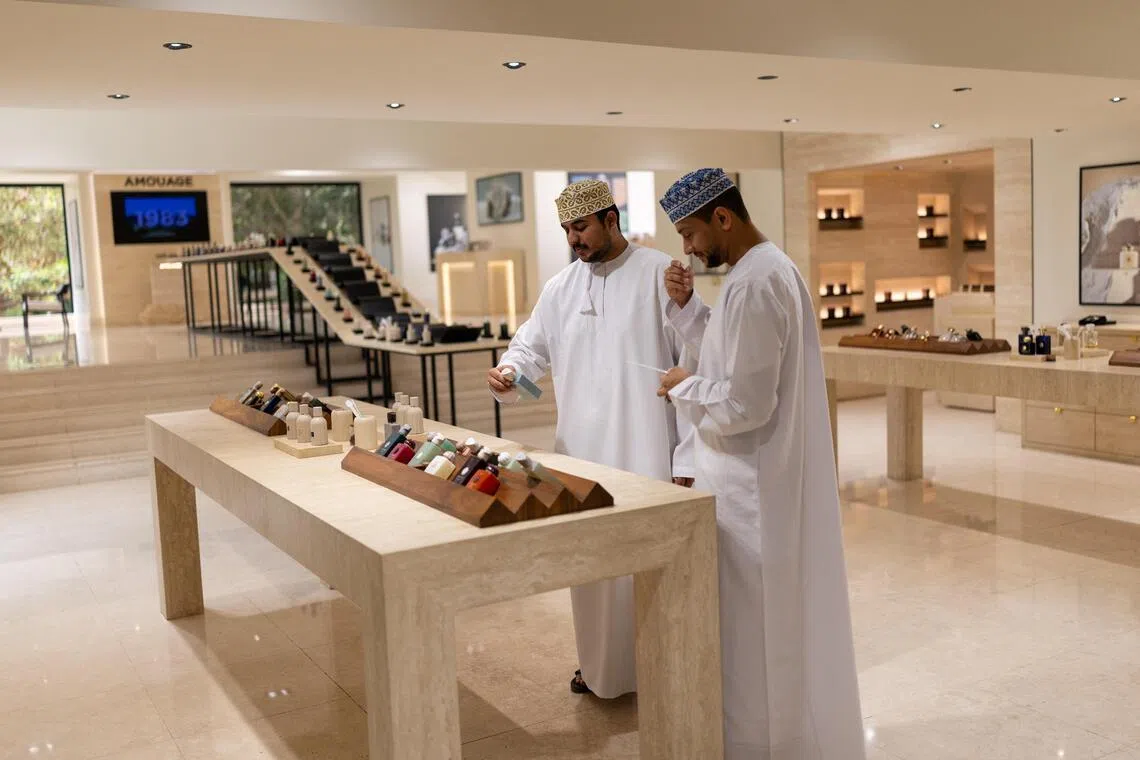
Men smelling perfumes inside a fragrance showroom in Muscat, Oman on March 17. PHOTO: REUTERS
The top 10 most popular sites to buy scents from via TikTok Shop sell mostly dupes, together generating around US$82 million in sales in the 12 months through March, data from Charm.io shows. While that is a fraction of what cosmetics giants sell, the popularity of replicas could take a chunk out of brand-name sales.
Shoppers who aspire to own premium and luxury fragrances, but have limited budgets, are driving demand for dupes and more affordable fragrance mists, according to Deborah Aitken, a senior analyst at Bloomberg Intelligence.
And unlike their fathers, who are more likely to have one cologne they have worn for decades, newer fragrance devotees tend to follow their noses, said Diana Melencio, a general partner at XRC Ventures who invests in the beauty sector.
The lack of loyalty “makes it harder to invest in a specific brand”, she said. “We’re all trying to figure out how to approach fragrance.”
With that fickleness, though, comes knowledge. Hall uses phrases like “scent profile” and “classic woodiness” to describe the fragrances he reviews, while Fino calls himself the “King of Gourmands” – a term to describe scents with notes based on edible ingredients like vanilla and cacao.
“They use words that are usually used by the master perfumer or the chemist,” said Jean Madar, chairman and chief executive of Inter Parfums, which manufactures and distributes fragrances for brands including Oscar de la Renta, MCM and Donna Karan.
Inter Parfum’s online sales were up more than 20 per cent year-over-year in the 12 months through April, buoyed by demand from young men buying items online from retailers like Ulta, Sephora and Macy’s, Madar said.
“They have all the vocabulary,” he said. “We have to adapt to this connoisseur.” BLOOMBERG